

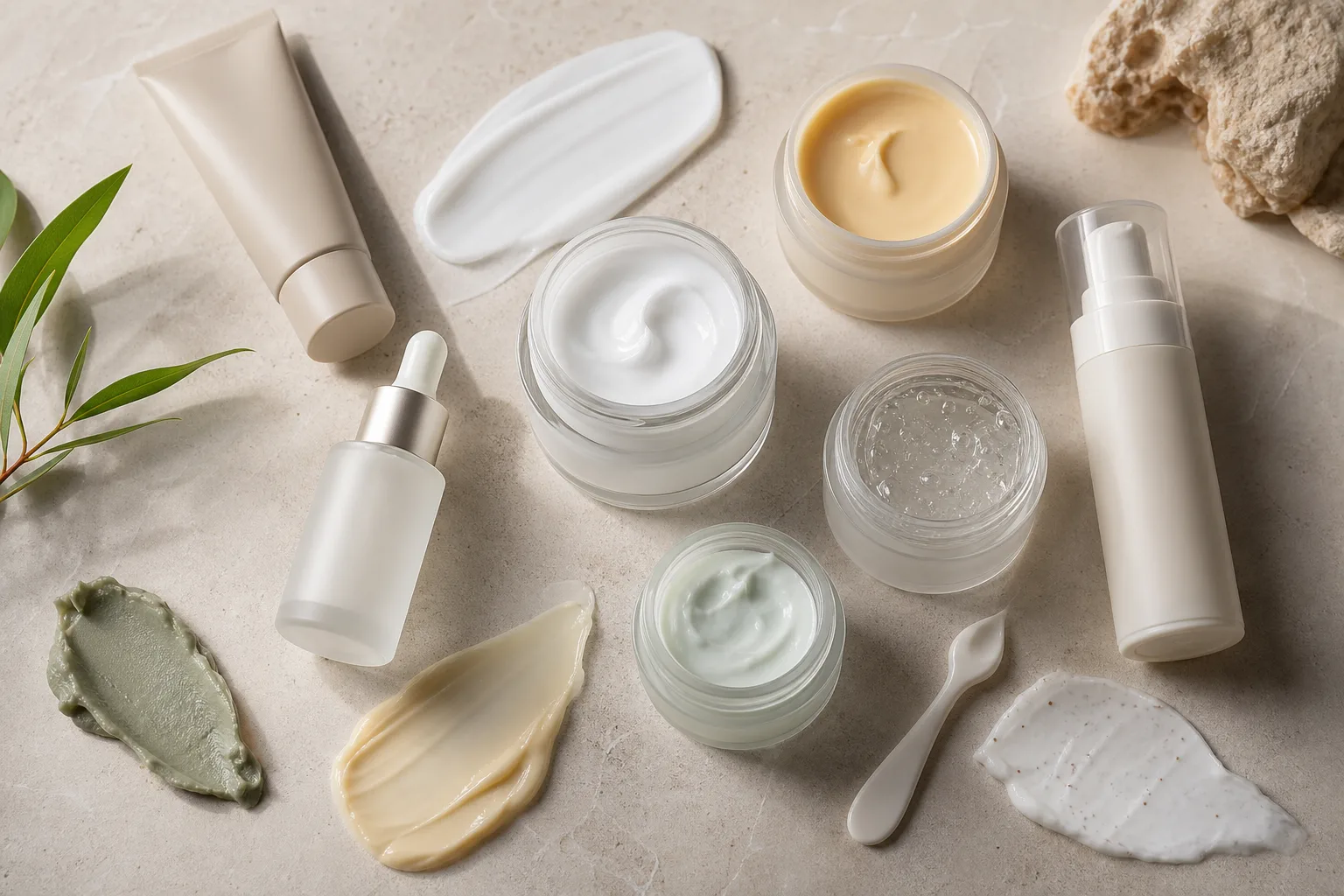
Texture: Types of Cosmetic Cream Textures
Different types of skincare cream textures in cosmetics are designed to meet different skincare needs. Our websitewww.lopsite.comhas outlined these differences for easy comparison in the table below.
If you repost information from this website on other websites, please credit LOPMETIC.COM. Thank you.
Cream texture type | Characteristics |
Cream | The thickest, most concentrated texture with high viscosity. |
Lotion | A light, fluid texture that absorbs faster than cream and is usually white. |
Emulsion | Lighter than cream but heavier than lotion, with fast absorption. |
Moisturizer | Lotions, creams, and emulsions that hydrate the skin when applied are collectively called “moisturizers.” |
Gel | A clear, gel-like texture that is usually translucent, absorbs easily into the skin, and leaves no sticky residue. |
Serum | A clear or milky-white liquid with a water-like flow and slight viscosity that absorbs easily into the skin. |
Essence | A milky-white or clear liquid with a watery consistency that absorbs easily into the skin. |
Fluid/Fluide | A milky-white liquid with a water-like flow that absorbs easily into the skin. |
Other Formats | Characteristics |
Oil | A viscous, oily, slippery liquid with no aqueous phase, such as boxing liniment oil or skink oil. |
Balm | A product used for topical application, rubbing, massage, and fragrance, with no clearly defined viscosity, such as lip balms and exfoliating balms. |
Bar Soap | Made by reacting fats or oils with an alkali to form soap that is solid at room temperature. |
Liquid Soap | Formed when fat or water reacts with an alkali, producing soap that is liquid at room temperature. |
Foam | Consists of air pockets in a liquid and produces lather when rubbed, as in facial cleansing foam. |
Mousse | Consists of gas dispersed in a liquid. It is more stable than foam and has smaller bubbles, with a soft, smooth texture that does not need to be rubbed to produce lather. Examples include facial cleansing mousse and hair styling mousse. |
Aerosol | A liquid or solid pressurized with an inert gas in a container and released as fine particles, as in powder hair styling sprays. |
Wax/Ointment | Made primarily of solid fats. Like an emulsion, it contains water and oil, but oil accounts for 80% or more. Examples include lip ointment and hair styling wax. |
Tonic | A liquid consisting mainly of alcohol, as in facial toners and nail polish removers. |
Paste | A formulation consisting primarily of a powder mixture compressed into a solid mass. Examples include pressed face powder and hair styling paste. |
Powder/Flakes | A solid ground into very fine particles, as in face powder and body powder. |
Brand creation services andCosmetic Manufacturing Services LOPMETIC International-Quality Cosmetics